
The phrase “secure the Blessings of Liberty” appears near the end of the Preamble to the U.S. Constitution. In simple terms, it means creating and maintaining a system of government that protects the freedoms and rights of people today and for future generations.
The Preamble identifies securing liberty as one of the Constitution’s broad purposes, alongside establishing justice, maintaining domestic peace, providing for common defense, and promoting the general welfare. The Preamble itself introduces the Constitution and describes its purposes, but it does not independently create specific legal rights or government powers.
What Are Blessings?

The word “blessings” generally means valuable benefits or good things. In the context of the Constitution, the expression “blessings of liberty” refers broadly to the benefits associated with living under a system that protects individual freedom.
These benefits can include:
- Freedom to express ideas and opinions
- Freedom of religion
- The ability to participate in civic life
- Protection against certain forms of government overreach
- Due process of law
- The ability to peacefully assemble and petition government
- Other constitutional liberties and protections
Many of these specific protections are found in the Constitution and its amendments rather than in the Preamble itself.
What Does Secure the Blessings of Liberty Mean?
“Secure the blessings of liberty” means to protect and preserve the benefits of freedom through a constitutional system of government.
The word secure is important. Liberty is not simply described as something valuable; the Preamble presents its protection as one of the purposes for establishing the Constitution.
In practical terms, this involves constitutional structures that limit government power, divide authority, establish courts and representative institutions, and protect individual rights.
What Are the Blessings of Liberty?
The blessings of liberty can be understood as the freedoms and protections people enjoy under constitutional government.
| Blessing of liberty | What it can involve |
| Freedom of speech | Expressing opinions and ideas |
| Religious liberty | Freedom of religion and conscience |
| Due process | Legal procedures and protections |
| Peaceful assembly | Gathering peacefully with others |
| Civic participation | Taking part in representative government |
| Personal liberty | Protection of individual freedom |
| Rule of law | Government operating under established law |
These examples should not be read as a complete list. Specific constitutional rights are established through the Constitution’s articles and amendments.
What Does Secure the Blessings of Liberty Mean in the Preamble?
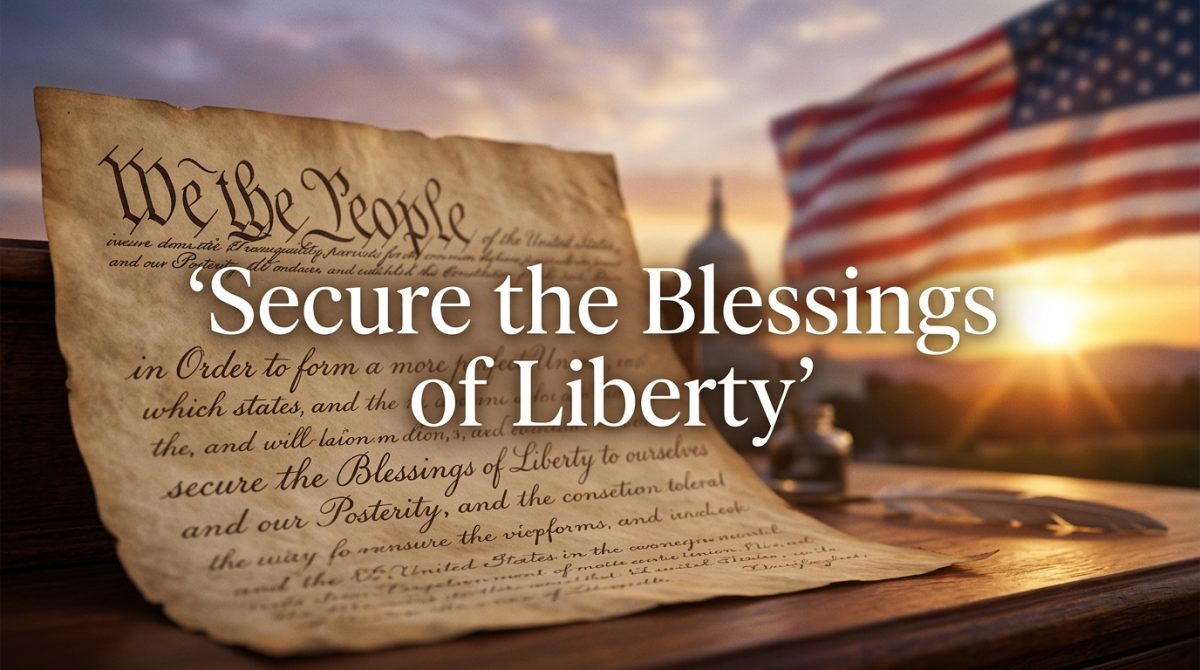
The Preamble describes six broad purposes of the Constitution:
- Form a more perfect Union
- Establish Justice
- Insure domestic Tranquility
- Provide for the common defense
- Promote the general Welfare
- Secure the Blessings of Liberty to ourselves and our Posterity
Thus, securing liberty is part of the larger constitutional purpose. The wording also makes clear that the vision extends beyond the people living when the Constitution was created.
What Does Secure the Blessings of Liberty Mean in Simple Terms?
In simple terms, it means:
Protect people’s freedom today and preserve those freedoms for future generations.
The idea is not simply to enjoy freedom but to maintain a governmental framework capable of protecting constitutional liberties over time.
What Does the Phrase Secure the Blessings of Liberty Mean in the Constitution?
The phrase describes a purpose of the Constitution, rather than a specific command found in an operative article.
This distinction matters. The U.S. Courts explain that the Preamble sets the stage for the Constitution and communicates the framers’ purposes, but it does not itself define individual rights or grant government powers.
The actual legal protections come from the Constitution’s articles and amendments.
What Does Secure the Blessings of Liberty Mean to Ourselves?
“Ourselves” refers to the people living under the constitutional system.
The phrase expresses an immediate objective: liberty was intended to be protected for the people of the United States, rather than treated only as an ideal for some distant future.
The Preamble begins with “We the People,” emphasizing popular sovereignty as the source of the Constitution’s authority.
What Does Secure the Blessings of Liberty Mean to Ourselves and Our Posterity?
“Our posterity” means future generations.
Therefore, the phrase has an intergenerational meaning. The Constitution was established not only for the people of the founding generation but also as a framework intended to endure and serve generations that followed.
This long-term purpose is one of the central ideas highlighted by constitutional scholarship on the Preamble.
The Interpretation of the Preamble of the U.S. Constitution
The Preamble is an introduction to the Constitution. It identifies the source of constitutional authority and summarizes broad purposes for which the Constitution was established.
The six purposes provide a useful framework for understanding the document:
- Union
- Justice
- Domestic tranquility
- Common defense
- General welfare
- Liberty
The Preamble therefore works as a concise statement of constitutional objectives rather than as a detailed list of enforceable rights.
What Does It Mean by Secure the Blessings of Liberty?
The phrase can be broken into three parts:
Secure means protect, preserve, or make lasting.
Blessings means valuable benefits.
Liberty means freedom within a constitutional and legal system.
Together, the phrase communicates the goal of protecting the benefits of freedom through constitutional government.
What Are the Blessings of Liberty?
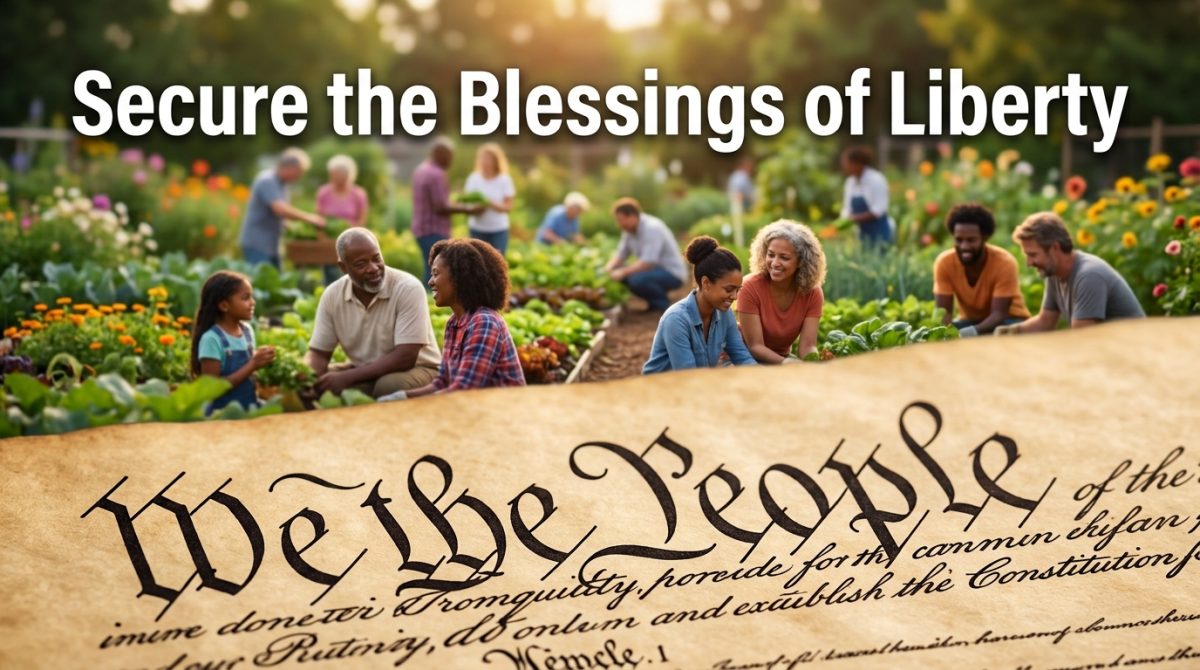
The Constitution’s system protects many forms of liberty through its structure and amendments. The Bill of Rights, for example, contains important protections concerning speech, religion, assembly, due process, and other liberties.
The Constitution Center notes that the Bill of Rights became an important part of the American culture of rights and liberties over time.
It is also important to remember that constitutional liberty operates within a legal system. Individual freedoms exist alongside laws, responsibilities, and protections for other people.
What Does “To Ourselves and Our Posterity” Mean?
This phrase expresses the idea that constitutional liberty should benefit both the present generation and generations yet to come.
“Posterity” is an older word for descendants or future generations. The wording therefore gives the Preamble a distinctly forward-looking character.
The framers were establishing a constitutional framework intended to endure beyond their own lifetimes.
The Founder’s Vision: Why the Achievement of Liberty Matters So Much
The Constitution was created in the aftermath of independence and under the experience of the Articles of Confederation. During the founding period, concerns about government power, individual rights, property, majority rule, and political stability influenced debates over the new constitutional structure.
The final Preamble presented liberty as one of the central purposes of the new constitutional government.
Its historical importance comes partly from the idea that government should not simply exercise power but should operate within a framework designed to protect constitutional principles.
The Way Government Gets the Blessings of Liberty

The constitutional system uses several mechanisms to protect liberty.
Separation of Powers
Federal authority is divided among legislative, executive, and judicial branches.
Checks and Balances
The branches have mechanisms for limiting or reviewing aspects of one another’s authority.
Written Constitutional Limits
The Constitution establishes powers and limitations that government officials must operate within.
Rights and Amendments
The amendments, particularly the Bill of Rights, provide important protections for individual liberty.
These structural features help explain how the constitutional system attempts to preserve liberty rather than relying only on a statement of ideals.
The Relationship Between Liberty and Justice
Liberty and justice are closely connected in the Preamble.
Freedom without legal protections can be vulnerable, while justice without respect for liberty can threaten individual freedom. The constitutional framework therefore places both concepts among its stated purposes.
The historical discussion of the Preamble also connects the goals of justice and liberty with concerns about protecting individual rights from government abuses and unchecked majority power.
Actual Lives of How to Find the Blessings of Liberty Today
The idea can be seen in ordinary civic life.
For example, people may experience constitutional liberty when they:
- Express an opinion peacefully
- Practice their religion
- Join a lawful organization
- Petition government
- Participate in elections
- Challenge government action through legal procedures
- Publish ideas and information
- Peacefully assemble with others
These examples illustrate how abstract constitutional principles can affect everyday life.
Below, the Existing Protection Areas Are Emphasized in the Table
| Area | Example of constitutional protection |
| Speech | Ability to express ideas subject to applicable law |
| Religion | Protection concerning religious exercise and government establishment |
| Assembly | Right to gather peacefully |
| Petition | Ability to petition government |
| Criminal procedure | Constitutional procedural safeguards |
| Equal protection | Constitutional protections against certain forms of discrimination by government |
| Due process | Legal protections before government deprives a person of protected interests |
The exact scope of these protections depends on the relevant constitutional provision, legislation, and judicial interpretation.
The Liberty of the Citizens: The Responsibility of Citizens
Liberty involves more than receiving rights from a constitutional system. A functioning constitutional society also depends on citizens respecting the rights of others and participating responsibly in civic life.
Responsible citizenship can include:
- Learning about constitutional principles
- Respecting lawful rights of others
- Participating peacefully in civic processes
- Understanding different viewpoints
- Following applicable laws
- Using freedoms responsibly
- Helping preserve constitutional institutions for future generations
The National Archives has emphasized the continuing responsibility of citizens to keep alive the Constitution’s ideals for future generations.
Why the Blessings of Liberty, Yet Secure, Still Matter Today
The phrase remains relevant because constitutional liberty is not presented as something that belongs only to one historical generation.
The words “ourselves and our Posterity” point toward continuity. Each generation inherits a constitutional system and faces new circumstances in determining how its principles apply.
At the same time, the legal meaning of specific rights comes from the Constitution’s operative provisions, amendments, statutes, and judicial decisions: not from the Preamble alone.
Conclusion
So, what does “secure the blessings of liberty” mean?
It means protecting and preserving the benefits of freedom through the constitutional system of government, for people living today and for future generations.
The phrase is found in the Preamble of the U.S. Constitution, where it appears among the document’s broad purposes. “Secure” emphasizes protection, “blessings” refers to the benefits of liberty, and “ourselves and our posterity” extends the idea across generations.
The Preamble does not itself create individual rights, but it provides an important statement of constitutional purpose. The Constitution’s articles and amendments establish the legal structures and protections through which many liberties are secured.
Frequently Asked Questions
What does “secure the blessings of liberty” mean?
It means protecting the benefits of freedom through constitutional government for people today and future generations.
What are the blessings of liberty?
They are the benefits associated with protected freedom, including important constitutional liberties such as speech, religion, assembly, and due process.
What does “our posterity” mean?
“Our posterity” means future generations and descendants who will live under the constitutional system.
Where does “secure the blessings of liberty” appear?
The phrase appears in the Preamble to the U.S. Constitution.
Does the Preamble create individual rights?
No. The Preamble describes broad constitutional purposes but does not itself grant individual rights or government powers.
Why is liberty included in the Preamble?
Liberty is included because the Constitution’s broad purposes include protecting the benefits of freedom.
What does “to ourselves” mean?
It refers to the people living under the newly established constitutional government and, more broadly, people living under that constitutional system.
How does the Constitution protect liberty?
It uses structures such as separation of powers, checks and balances, constitutional limitations, courts, and amendments that protect individual rights.
What is the simplest meaning of the phrase?
In simple terms, it means protecting freedom now and preserving it for future generations.

Lilly Ella is a writer and content creator at Blessingliy, passionate about creating meaningful blessings, heartfelt wishes, prayers, and inspirational messages for everyday moments.